
WORSHIP ARTICLE | Jeffrey Smith | Melbourne, Florida
When it comes to physically building things, I just do not have the gift. I recall building model cars in my teens. When my friend was done with his model it was ready to be proudly displayed on the shelf. When mine was finished, I wanted to put it back in the box and slide it under the bed. My friend had the gift of building models; I didn’t.
I have a friend today who can build anything. When he is done it looks perfect. But I try to avoid building projects because when I’m done, typically, I have to call my friend to fix it up and make it look right. I still don’t have the gift of building things.
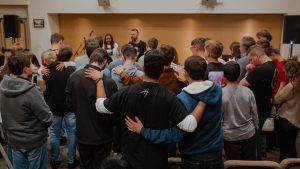
But there’s another kind of building: building people. I mean building them up spiritually; helping them develop deeper faith, richer knowledge of the scriptures, and stronger love for the Lord. Building people is much more important in the Lord’s kingdom than building things. I don’t mind admitting that I am a poor physical builder, but may it never be said of me or any saint that we are poor builders of people.
Building people is a primary work of the church. Paul told the Corinthians, “Let all things be done for building up” (1 Corinthians 14:26b). That is the goal of all our labor; building brethren up.
As with physically building things, it is possible to be a poor builder of people. The context of the above reference was an instance where saints were using their spiritual gifts to build themselves up at the expense of fellow saints. Building up self usually results in tearing others down, and that is the opposite of our true purpose. It defeats the true purpose.
We have many other examples in the scriptures of poor spiritual builders. Some teachers in the first century were focusing on genealogies (1 Timothy 1:4). Most likely these were Jewish teachers who had genealogies of which they were proud. As they bragged about their genealogy, they made those with undistinguished lineage self-conscious. But our genealogy does not determine our faithfulness to the Lord (Ezekiel 18). Paul forbade focusing on genealogies noting that the result would be unproductive speculation instead of profitable certainty. These teachers were edifying themselves at the expense of their students.
Similar problems occurred elsewhere. Certain men crept into households where women didn’t know any better, taught lessons regularly, appeared to be Godly, but no one ever learned any truth in their classes (2 Timothy 3:1-9). The offenders were likened to Jannes and Jambres, the Egyptian “magicians” who withstood Moses as he confronted Pharaoh (Exodus 7:11). What a terrible legacy.
Paul said more about such teaching later in his first letter to Timothy. Instead of building people up, some teachers liked to stir things up. They were conceited and refused to accept sound doctrine. They saw building a bank account as more important than building people (1 Timothy 6:3-5).
Teachers aren’t the only ones responsible for poor teaching. Sometimes the students are at fault. Students can have the goal of hearing pleasant teaching instead of hearing truth. Paul called this phenomenon, “having itching ears” (2 Timothy 4:3-4). Such were the bulk of those who heard Paul preach at the Areopagus in Acts 17. Their goal was not to answer a question, but to always be studying some question (Acts 17:21).
There are too many examples of poor spiritual building in the New Testament. Paul employed a figure to describe the difference between building up and puffing up.
“Now concerning food offered to idols: we know that “all of us possess knowledge.” This “knowledge” puffs up, but love builds up.” (1 Corinthians 8:1, ESV)
Puffing up is how we inflate a balloon. Balloons have volume but no real weight. There’s nothing in them. Contrast a balloon with a medicine ball. There is substance in a medicine ball. One is built up and the other is puffed up.
Consider two comments on this from two commentaries.
Paul’s critique of “knowledge that puffs up” in 1 Corinthians 8 reveals a profound spiritual principle about Christian understansing and love. He identifies pride as the core Corinthian problem and opens with the assertion that “knowledge puffs up, but love builds up,” which sets the stage for his entire discussion[1].
The term “puffed up” is significant— literally meaning to be “blown up or inflated.” Paul warns that a believer could be full of knowledge about Christ’s freedom, yet simultaneously cause a weaker believer to sin[2]. The distinction is stark: knowledge merely says, “All things are lawful for me,” while love adds “But all things do not edify.” Knowledge seeks to please oneself, whereas love seeks to please one’s neighbor[3]. In contrast, love prevents self-focus, creates other-focus, and builds up others. When carefully examined, love’s characteristics align with the fruit of the Spirit, releasing spiritual power in our lives and churches[2][4]. Critically, the first step to true knowledge is recognizing our own ignorance—without love, we possess only the appearance of knowledge[3].
Paul told the Ephesian saints that our Savior has provided for us to mutually edify one another completely and perfectly (Ephesians 4:11-16). Our Lord purposed us to fill different roles in the church (vs. 11) to equip the church to build itself up (vs. 12). The goal is to build each other up so that we think and act like Christ (vs. 13). If we are properly built up, we won’t be deceived by false teachers or false teaching (vs. 14). Instead, we will speak the truth in love (vs. 15).
If you take away nothing else from this article, remember that phrase: “speaking the truth in love.” That means sharing the right message the right way. If we do that, we will be builders whose work will withstand the fire of judgment (1 Corinthians 3:13). And, having built properly, we will receive our reward (vs. 14).
Practically speaking, put away pride and selfishness. Don’t try to lift yourself up. It doesn’t work and it is really annoying. Instead, selflessly lift others up by speaking the truth in love. Catch them doing good deeds. Notice their finer qualities and compliment them. Tell them they are important. Tell them you love them. Little efforts to build up a brother aren’t little, at all. They are hugely important in the Kingdom.
We may or may not be capable physical builders. No worries if you, as I, don’t have that gift. But we all can and must develop the skill of building up others in the church. Let us become expert builders of our brethren.
[1] Mark Taylor, 1 Corinthians, ed. E. Ray Clendenen, The New American Commentary (Nashville, TN: B&H Publishing Group, 2014), 28:202.
[2] Dwight L. Hunt, “The First Epistle of Paul the Apostle to the Corinthians,” in The Grace New Testament Commentary, ed. Robert N. Wilkin (Denton, TX: Grace Evangelical Society, 2010), 736–737.
[3] Robert Jamieson, A. R. Fausset, and David Brown, Commentary Critical and Explanatory on the Whole Bible (Oak Harbor, WA: Logos Research Systems, Inc., 1997), 2:277.
[4] Warren W. Wiersbe, The Bible Exposition Commentary (Wheaton, IL: Victor Books, 1996), 1:611.
_____________________________
January 2026 | GROW magazine
Download PDF of the January 2026 issue
